
Clean agent fire suppression
Clean agent fire suppression knocks down a fire using a gas that won't conduct electricity and leaves nothing behind, which is why it gets chosen to guard delicate electronics such as servers. NFPA's explainer also points to museum artifacts as something these systems look after.
- How fast a data center fire is put out 10 seconds
- Shortest time the room has to keep the gas in 10 minutes
- A small server room, fully fitted $2,500 to $5,000
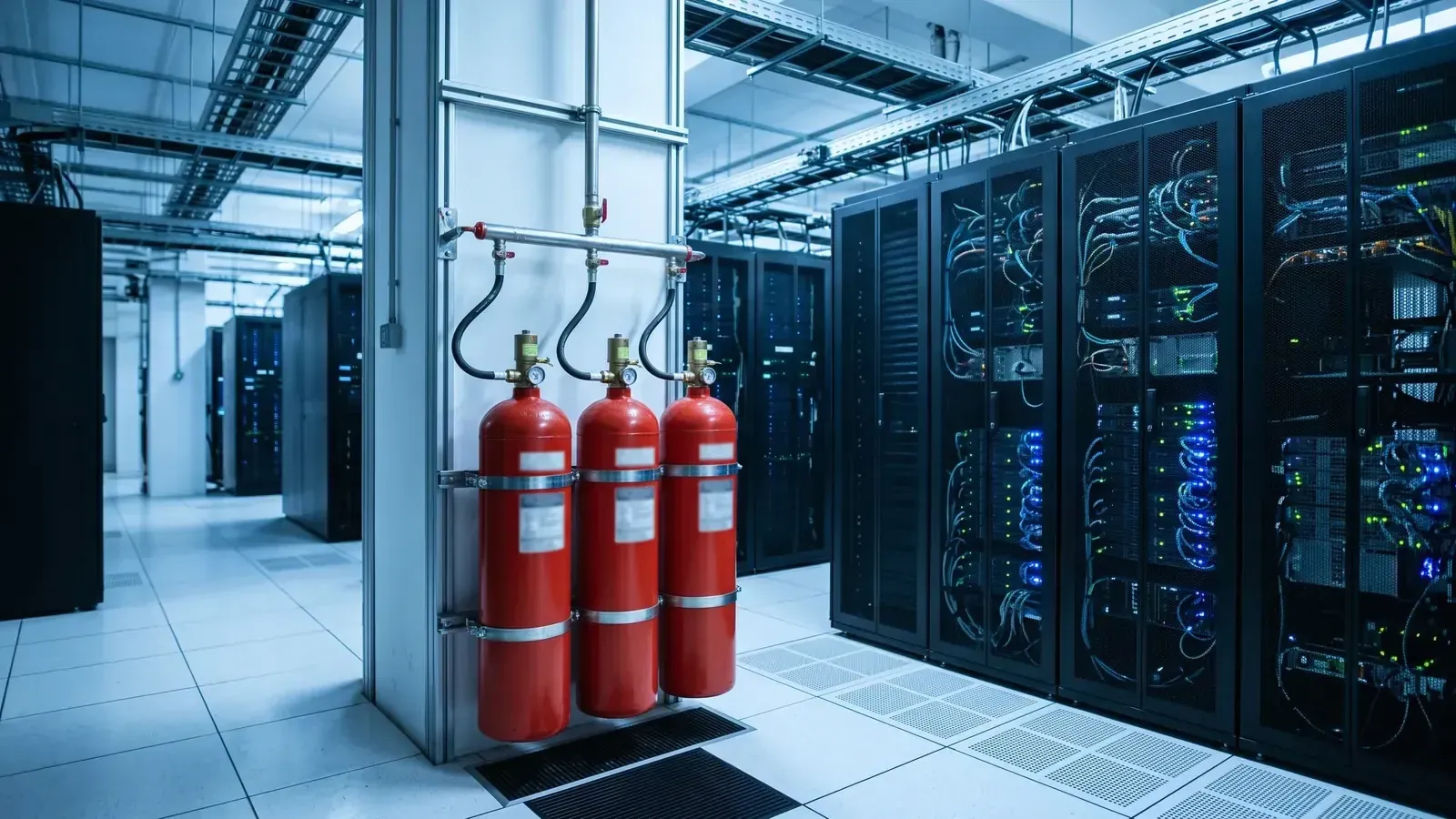
What makes an agent clean?
A clean agent is a fire-fighting gas that won't conduct electricity and leaves no residue behind. That's important when whatever is in the room would be destroyed by water or powder.
Clean agents come in 2 families. Halocarbon agents are chemical gases originally created as a replacement for halon, a fire suppression gas from an earlier era. Inert gas agents are ordinary gases like helium, neon, argon, or nitrogen.
The gas does its job only if it remains in the room for long enough. Because of that, the room being protected must be sealed tightly enough to keep the right concentration of gas in place.
FM-200 and the HFC reduction
FM-200 belongs to the halocarbon group of clean agents, and its chemical name is HFC-227ea. That places it among the HFCs, short for hydrofluorocarbons.
The AIM Act, a US law, gives the EPA the power to gradually reduce the amount of HFC gas made and used. This is a step-by-step cut in supply rather than a sudden prohibition.
| Agent | Chemical name | Group |
|---|---|---|
| Inert gas | Nitrogen, argon, helium, or neon | Inert gas |
| Novec 1230 | FK-5-1-12 | Halocarbon |
| FM-200 | HFC-227ea | Halocarbon |
Which suppression systems do data centers rely on?
Clean agent gas is a common choice in data centers, since it guards the room without getting the equipment wet. According to a summary of the standard, a data center system is expected to suppress a fire within 10 seconds.
Pre-action sprinklers are also found in many data centers. With these, the lines stay dry until a fire is detected, meaning water isn't sitting over the racks day in, day out.
NFPA 75 is a separate standard covering fire protection for IT equipment and the rooms where it lives.
NFPA 2001, the clean agent standard
The standard that covers clean agent systems is NFPA 2001. It requires a minimum hold time of 10 minutes, so the room must hold on to enough gas for at least that long. A door fan test checks this: a fan gets placed in the doorway to see how well the room retains air.
The standard also lays out a routine schedule of checks. Sticking to it helps ensure the system will work the moment it's called on.
| Interval | What's inspected |
|---|---|
| Monthly | A visual look at cylinders, gauges, and actuators |
| Every 6 months | Each container gets a check |
| Every year | A working test of the detection and release panel |
| Every 5 years | A high-pressure water test of the cylinders |
In a hydrostatic test, each cylinder is filled with water at high pressure to confirm it is still strong enough to keep the gas in safely.
Clean agent system cost
Pricing is generally quoted by the square foot of protected room. These numbers come from one supplier's published pricing guide.
| System | Price per sq ft |
|---|---|
| FM-200 system | $4–$10 |
| Novec 1230 system | $6–$12 |
| CO2 | $6–$15 |
The same guide prices a small server room at $2,500 to $5,000 installed, and permits typically add $200 to $800 on commercial jobs.
Questions people ask
Does FM-200 count as a clean agent?
It is. FM-200 is a halocarbon agent, one of the two clean agent families.
What happened to Novec 1230?
3M announced plans to end production of Novec 1230 by 2025. Other manufacturers now sell fluoroketone-based replacements that drop straight into existing Novec 1230 setups.
How do CO2 and clean agent systems differ?
Because CO2 can harm people, the NFPA doesn't treat it as a clean agent. Fresh CO2 systems don't go into occupied rooms, and NFPA 12 is the standard they follow.
Where else do clean agent systems show up?
Beyond server rooms, clean agents also guard CNC and EDM equipment, electrical enclosures, and wind turbines. Battery energy storage is covered by its own standard, NFPA 855.
What about paint booths?
Paint booths usually rely on dry chemical systems instead. According to one supplier's cost guide, these run $3,000 to $7,500.