
Fire alarm monitoring
Fire alarm monitoring means a staffed station gets the signals from your alarm panel. For a business it usually costs about $50 to $100 a month, though some guides put it as low as $25.
- Usual monthly price about $50 to $100 for business monitoring
- UL certification often $495 to $1,295 per year in many cities
- Station standard a central station meets UL 827
- Phone line shift copper lines are being phased out by carriers
What does fire alarm monitoring cost?
A guide from one security company puts commercial monitoring at roughly $50 to $100 a month. A guide from a fire protection contractor offers a broader spread of $25 to $100 a month.
In many cities, getting UL certification for your monitoring adds about $495 to $1,295 a year. So what you'll pay in the end depends on where your building is as well as which company you choose.
Central station
A central station is a monitoring center that meets a safety standard called UL 827. It also keeps records, tests your system, and provides a runner service, which means it can send someone to the building.
Central stations are just one option among several. The National Fire Protection Association lays out the rest this way:
| Kind of station | What it means |
|---|---|
| Remote supervising station | Staffed around the clock, it takes signals from buildings owned by different people |
| Proprietary station | Owned by the same organization as the building it serves; common at airports, plants, campuses, hospitals, and retail chains |
| Auxiliary system | A link into a city or town fire alarm system |
The building or life safety code in force where you are generally decides which kind you need. Before committing to anything, ask each company which type it operates.
Fire alarm communicator
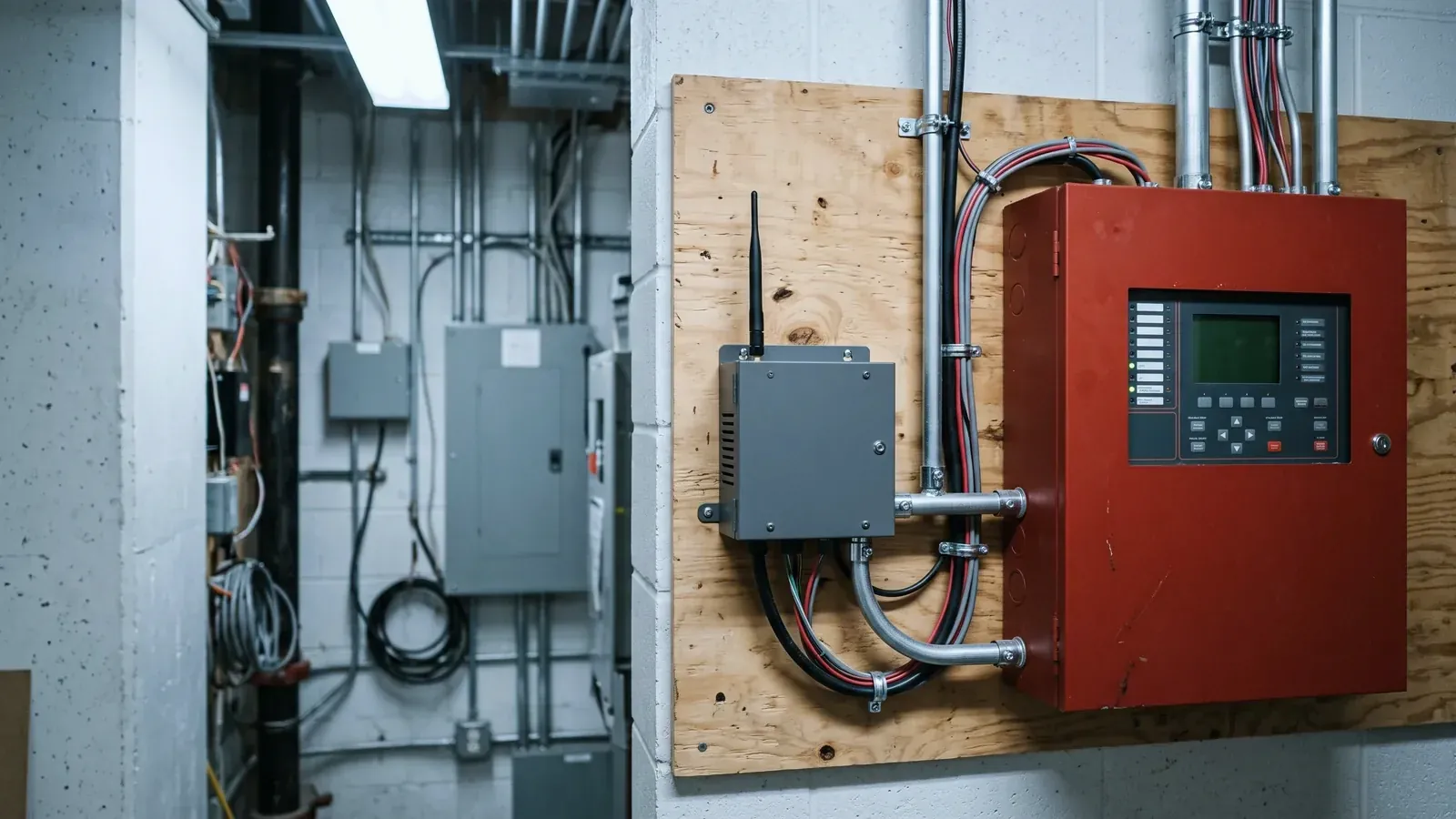
Your alarm panel sends its signals to the station over a phone line or another connection. The panel, known as the control unit, acts as the system's brain. It shows three signal types: alarm, supervisory, and trouble.
For nearly 40 years, phone lines were a main way to send these signals. These days signals can move over landline, cellular, internet, or a mix of these, often with a backup path in place. Cellular transmitters keep gaining ground.
Why does this matter? Carriers are retiring copper phone networks. Before doing so, they must give notice to retail customers. A copper landline works during a power outage, while the newer options need backup power.
Sprinkler signals and monitoring
When your building has sprinklers, the panel commonly reports on those as well. New buildings are generally required by model fire codes to monitor sprinkler waterflow. Building codes also expect the alarm panel to keep watch over the valves that feed water to your sprinklers, so a closed valve gets noticed.
The waterflow alarm lets people outside the building know the sprinklers have activated. On systems with more than 20 sprinklers, the sprinkler standard NFPA 13 calls for a local one.
If a sprinkler valve is closed, that registers as a supervisory signal. That matters because sprinklers usually work. In fires big enough to set them off, they did their job 92% of the time. When they failed, the most common reason, 3 times out of 5, was that the system had been shut off.
Questions people ask
Must a fire alarm be monitored?
It depends on where your building is. The rules for supervising stations are written into the building or life safety code your area uses.
Must sprinkler valves stay fully open?
Yes. This supervision confirms that control and isolation valves are fully open, so water can reach the sprinklers when needed.