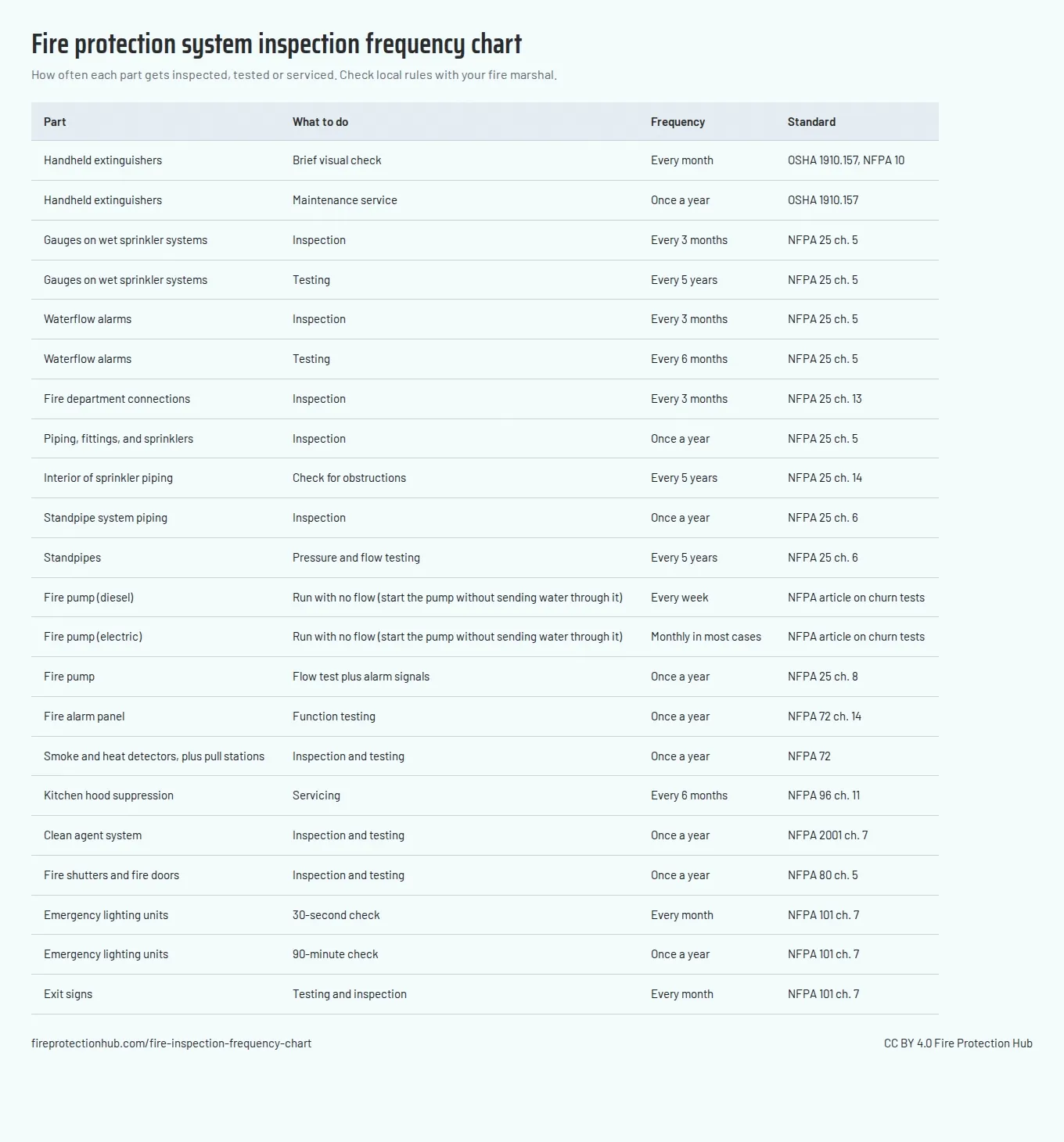
Fire protection system inspection frequency chart
A fire protection system inspection isn't one yearly visit. Each part has its own schedule, from a weekly fire pump run to tests that come around only every 5, 12, or even 50 years. Below, the chart and the sections under it lay out how often each component needs attention, so you can see what's due soon and what's still a ways off.
- Extinguishers a quick look each month, plus maintenance once a year
- Sprinkler gauges and fire department connections every quarter
- Fire alarm devices and the control panel once a year
- Inside of sprinkler pipes every 5 years
How often does each part need attention?
Most of this chart comes from a NIST facilities guide that summarizes the main fire safety standards. It doesn't list edition years, so ask your local fire official which edition applies where you are.
| Part | What to do | Frequency | Standard |
|---|---|---|---|
| Handheld extinguishers | Brief visual check | Every month | OSHA 1910.157, NFPA 10 |
| Handheld extinguishers | Maintenance service | Once a year | OSHA 1910.157 |
| Gauges on wet sprinkler systems | Inspection | Every 3 months | NFPA 25 ch. 5 |
| Gauges on wet sprinkler systems | Testing | Every 5 years | NFPA 25 ch. 5 |
| Waterflow alarms | Inspection | Every 3 months | NFPA 25 ch. 5 |
| Waterflow alarms | Testing | Every 6 months | NFPA 25 ch. 5 |
| Fire department connections | Inspection | Every 3 months | NFPA 25 ch. 13 |
| Piping, fittings, and sprinklers | Inspection | Once a year | NFPA 25 ch. 5 |
| Interior of sprinkler piping | Check for obstructions | Every 5 years | NFPA 25 ch. 14 |
| Standpipe system piping | Inspection | Once a year | NFPA 25 ch. 6 |
| Standpipes | Pressure and flow testing | Every 5 years | NFPA 25 ch. 6 |
| Fire pump (diesel) | Run with no flow (start the pump without sending water through it) | Every week | NFPA article on churn tests |
| Fire pump (electric) | Run with no flow (start the pump without sending water through it) | Monthly in most cases | NFPA article on churn tests |
| Fire pump | Flow test plus alarm signals | Once a year | NFPA 25 ch. 8 |
| Fire alarm panel | Function testing | Once a year | NFPA 72 ch. 14 |
| Smoke and heat detectors, plus pull stations | Inspection and testing | Once a year | NFPA 72 |
| Kitchen hood suppression | Servicing | Every 6 months | NFPA 96 ch. 11 |
| Clean agent system | Inspection and testing | Once a year | NFPA 2001 ch. 7 |
| Fire shutters and fire doors | Inspection and testing | Once a year | NFPA 80 ch. 5 |
| Emergency lighting units | 30-second check | Every month | NFPA 101 ch. 7 |
| Emergency lighting units | 90-minute check | Once a year | NFPA 101 ch. 7 |
| Exit signs | Testing and inspection | Every month | NFPA 101 ch. 7 |
Fire alarm testing
NFPA 72 calls for the core fire alarm components to be inspected and tested annually. The NIST directive spells out these annual items:
- Check that the control panel functions work
- Look over and test each smoke detector
- Look over and test the heat detectors and manual pull stations
- Look over and test the alarm communicator, the part that sends alarm signals to a monitoring center
For buildings with a fire pump, the pump's alarm signals get their own yearly test as well, right alongside the annual flow test.
Sprinkler items due every 3 months
A handful of sprinkler components get checked every 3 months. With a wet system, where the pipes always hold water, the gauges get a quarterly inspection. Waterflow alarm devices, both the vane style and the pressure-switch style, are inspected on the same quarterly rhythm and then tested two times a year. Fire department connections, the spots where crews attach their hoses, also get a quarterly inspection, per NIST's restatement of NFPA 25.
Some buildings also run a main drain test each quarter. This test verifies the water supply by opening up the system's main drain. That quarterly timing kicks in when the only water supply comes in through a backflow preventer or pressure-reducing valve.
Sprinkler items due once a year
The bigger sprinkler items land once a year. Each of these comes out of NFPA 25:
- Sprinklers, pipe, and fittings get a look
- The main drain test gets done where it isn't already required quarterly
- Backflow prevention assemblies get tested
- Antifreeze solution is kept up where the system carries it
- Dry pipe valves are trip-tested, and every 3 years that test is done with a full flow of water
Standpipe piping also gets an annual inspection.
Sprinkler work on the 5, 10, and 50 year cycle
Certain sprinkler jobs only come around on a far longer timeline. Every 5 years, the interior of the sprinkler piping is examined for blockages, and the gauges on a wet system get tested. Standpipes, the water pipes that firefighters connect hoses to inside the building, receive both a pressure test and a flow test at that same 5 year mark.
The schedule lists sprinkler testing at 50 years of age and every 10 years after that, per the NIST directive. Sprinklers also receive an annual inspection.
Checking and testing fire extinguishers
Under NFPA 10, extinguishers get checked at installation and then monthly after that. No certification is required for the monthly look, so your own building staff can handle it. Maintenance is a separate matter, and it calls for someone certified.
In the workplace, OSHA requires a visual check each month plus a maintenance check each year. The yearly maintenance date gets written down, and that record stays on file for 1 year past the final entry.
A hydrostatic test puts the extinguisher's cylinder under pressure. How often it's needed depends on the kind of extinguisher:
| Extinguisher kind | Test interval |
|---|---|
| Carbon dioxide | Once every 5 years |
| Water and wetting agent (stored pressure) | Once every 5 years |
| AFFF foam, loaded stream, and stainless steel dry chemical types | Once every 5 years |
| Dry chemical (stored pressure) with a mild steel, brass, or aluminum shell | Once every 12 years |
| Halon 1211 and 1301 | Once every 12 years |
The stored pressure dry chemical units on the 12 year cycle also get emptied and serviced every 6 years. Throwaway dry chemical units don't fall under that 6 year requirement. Nonrechargeable units come out of service once they reach 12 years.
Fire pump runs each week and month
A churn test means running the fire pump while no water moves through it. Diesel fire pumps run this test each week, while most electric fire pumps run it each month, according to NFPA.
Some electric pumps still need a weekly run. These are pumps in buildings too tall or large for fire department trucks to supply on their own, and pumps with simpler "limited service" controls, unless a second backup fire pump is in place. With either pump type, an approved risk analysis can stretch out the gap between tests.
Kitchen hood systems and exhaust cleaning
Commercial kitchens have their suppression system serviced two times a year, and the metal alloy fusible links get swapped out two times a year as well, under NFPA 96. Wet chemical containers go through pressure testing every 12 years.
The grease exhaust system follows its own inspection calendar, tied to how heavily the kitchen cooks. Massachusetts lays out the timing under 527 CMR 1.00, chapter 50 of the State Fire Code:
| Cooking type | Inspection frequency |
|---|---|
| Solid fuel cooking | Every month |
| High volume, such as round-the-clock cooking, charbroiling, or wok cooking | Every 3 months |
| Moderate volume | Every 6 months |
| Low volume, such as churches, day camps, seasonal businesses, and senior centers | Once a year |
What each inspection finds determines whether the exhaust needs to be cleaned.
Fire doors, clean agent systems, and emergency lighting
Under NFPA 80 section 5.2.4, fire doors get inspected and tested right after installation and then no less than once a year. Whoever performs the work has to be qualified and approved by the local office or official who enforces the fire code. Sometimes the owner can fill that role. Fire shutters follow the same yearly inspection and testing schedule.
Clean agent systems are inspected and tested annually, the room they protect is inspected annually, and the agent cylinders get a look every 5 years.
Emergency lights receive a 30-second test each month and a 90-minute test each year. Exit signs get tested and inspected monthly.
A sample schedule for a 3-story office building
Imagine a 3-story office building equipped with sprinklers, a fire alarm, and a kitchen hood in the small break room. For this example, assume the building has a wet sprinkler system. The hood schedules below apply only if its kitchen has commercial cooking equipment.
- Every month: extinguisher walk-throughs, the 30-second emergency light test, and exit sign checks
- Every quarter: gauge checks on the sprinklers, the waterflow alarm devices, and the fire department connection
- Every 6 months: testing the waterflow alarm devices, servicing the kitchen hood suppression, and the exhaust inspection
- Once a year: sprinkler and pipe inspections, the main drain test, testing of the fire alarm panel and detectors, extinguisher maintenance, fire door inspections, and the 90-minute emergency light test
- At 5-year intervals: the inside of the sprinkler piping and the gauge test
If a backflow preventer is the only path for the building's water supply, the main drain test shifts from a yearly item to a quarterly one, while the backflow assembly gets its test once a year.
Get the chart as a CSV or the chart image, or print it from your browser. Inspection intervals chart by Fire Protection Hub, CC BY 4.0. You're free to reuse it with a link back.