
Fire sprinkler inspection
A fire sprinkler inspection is a planned review of the valves, gauges, piping, and sprinkler heads throughout your building, so water flows when a fire starts. NFPA 25 sets the schedule, and the building owner has to make sure it happens.
- Yearly visits spaced 9 to 15 months apart
- Internal valve inspections on a 5-year cycle
- Annual cost for buildings below 10,000 sq ft $500 - $1,500 USD a year
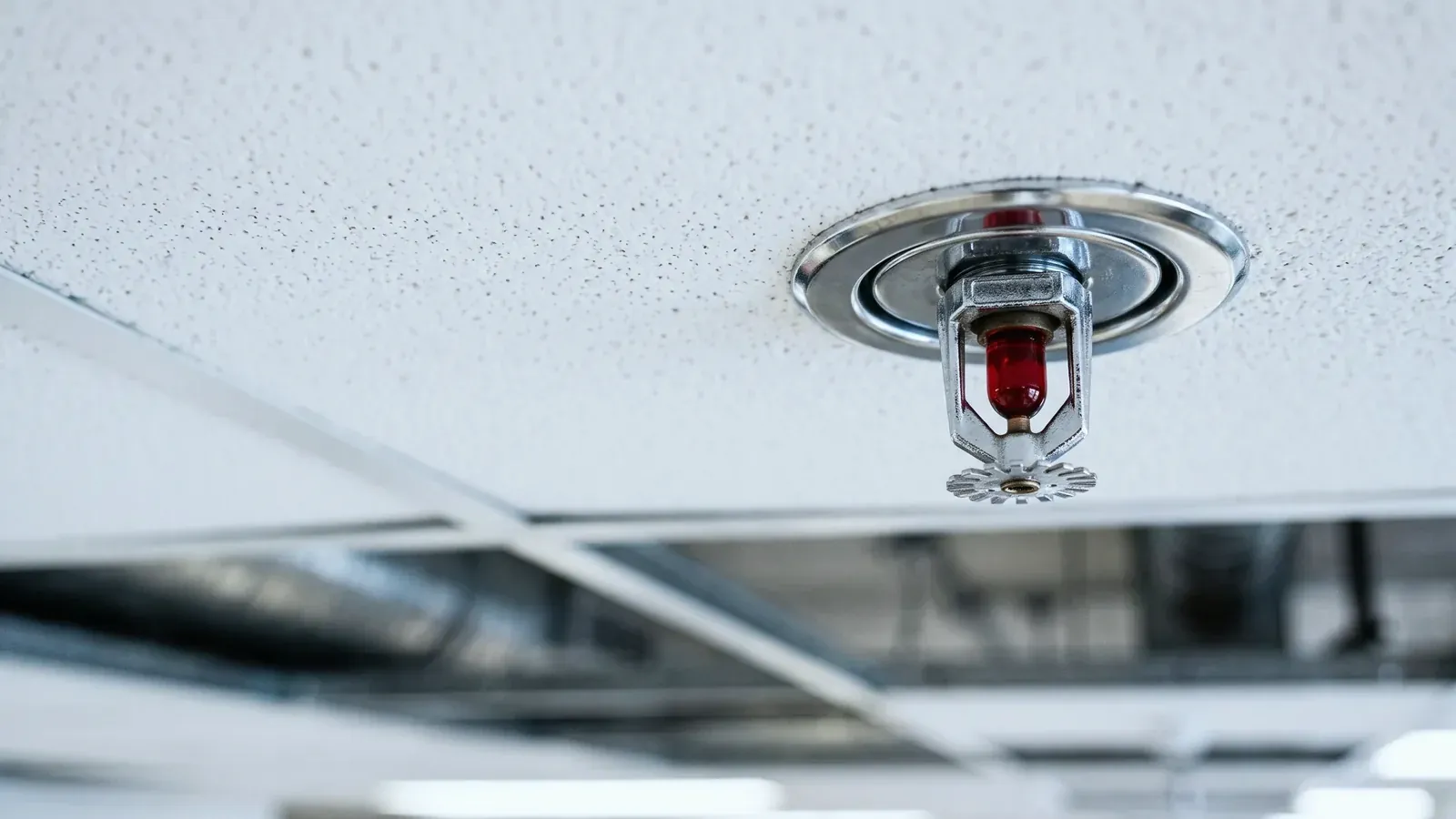
The NFPA 25 inspection timetable
NFPA 25 sets the rules for the inspection, testing, and upkeep of water-based sprinkler systems. An inspection means looking the system over. A test means making a part move or letting water flow. Every component follows its own timetable.
| Frequency | Items to check |
|---|---|
| Weekly | Backflow preventer, the device that keeps sprinkler water out of your drinking water; control valves, the shutoffs that must stay open (monthly if they're locked open, quarterly if an alarm watches them) |
| Monthly | Gauges; dry pipe valve exterior |
| Quarterly | Alarm valve exterior; fire department connection, the outside inlet where firefighters pump in water; supervisory devices, which signal when a valve is closed; waterflow alarms |
| Twice a year | Testing of the control valve supervisory devices, plus a waterflow alarm test |
| Annually | Sprinklers and hangers viewed from the floor; dry pipe valve interior; tests covering the control valves, the backflow preventer, the main drain, and a dry valve trip |
| Every 3 years | Full-flow dry valve test |
| Every 5 years | Alarm and check valve interiors; backflow preventer interior; gauges |
| 5 to 75 years | Sample testing of sprinklers |
For an annual inspection, NFPA allows 9 to 15 months between inspections.
Who can do the inspection?
As the owner, you carry the responsibility, and the work must be done by someone qualified. "Qualified" means trained in a way your local fire department or your insurance company accepts.
Plenty of the simple checks are things you can handle on your own. Checking each month that the control valves are open is one example.
What the yearly visual check looks for
The sprinklers get looked at from floor level. The technician checks for leaks, corrosion, physical damage, and bulbs that no longer hold their fluid. They also watch for heads coated in dust or grime, paint that wasn't applied at the factory, and heads pointing the wrong direction.
Storage stacked too near the sprinkler deflectors, the small plates that spread the water, can block the spray pattern. Any sprinkler that leaks or shows damage must be swapped out.
NFPA 13 and your system's original design
NFPA 13 governs how systems get installed, and NFPA 25 covers the upkeep of everything NFPA 13 lays out.
Not every problem an inspector finds is equally urgent. NFPA distinguishes between critical and noncritical deficiencies, so ask the person inspecting your system to explain any findings and what needs to happen next.
When a system must be shut down, NFPA 25 Chapter 15 requires the owner to name an impairment coordinator, the person in charge while the system is out of service. A tag goes on every fire department connection and on the main control valve, and the fire department gets notified. If the sprinklers will be off for more than 10 hours in a 24-hour period, you'll need extra protection, such as an approved fire watch, as NFPA explains.
Fire sprinkler inspection cost
A cost guide from one contractor lists annual prices according to building size.
| Size of building | Annual cost |
|---|---|
| Below 10,000 sq ft | $500 - $1,500 |
| 10,000 to 50,000 sq ft | $750 - $1,500 |
| 50,000 to 100,000 sq ft | $1,500 - $3,000 |
| 100,000 to 250,000 sq ft | $2,500 - $5,000 |
Certain services carry their own price tags. That same guide prices an annual backflow test at $250 to $500. For a small property, the five-year internal inspection typically costs $1,000 to $3,000, while a large one can run $5,000 to $10,000 or higher.
A different contractor prices an internal check valve inspection near $100 and a fire department connection test at roughly $400.
Replacing sprinkler heads
Sprinkler heads cannot be fixed. The National Fire Sprinkler Association says replacement is the only option. NFPA 25 requires swapping out heads that are under recall, damaged, corroded, coated with grime or paint, or that didn't pass field tests.
Parts for commercial heads run $8 to $40 each, according to one cost guide. One contractor estimates $200 to $800 for a single head in a typical commercial setting, with difficult jobs going beyond $1,000 per head. How many heads you have is one of the main things that drives the price. Before work starts, the zone's water gets shut off and drained or isolated.
Recalled sprinklers
US recalls are typically announced by the CPSC, the Consumer Product Safety Commission. O-ring heads made by Central Sprinkler from the mid-1970s through June 2001 were recalled in July 2001. The CPSC says contaminants can break down the O-ring seals, so those heads might not activate during a fire.
Swapping out recalled heads falls to the owner, and a qualified professional should handle the job. Don't try to remove or identify sprinklers on your own. Technicians confirm model numbers and date codes. Document what was found and what was replaced, and check your maintenance records to be sure recalled units came out.
Leaks and corrosion
Leaks tend to trace back to 3 places: the heads, the pipes and fittings, or the valve assemblies. If you find a leak, one fire protection company recommends shutting off the sprinkler water, which leaves the system out of service and calls for impairment procedures.
Corrosion causes pinhole leaks. It may also block the opening a sprinkler sprays through or fuse the plug shut.
Frequently asked questions
What does a small 5-year internal inspection cost?
For a small property it typically runs $1,000 to $3,000, and a single internal check valve inspection can be about $100.
Does a new sprinkler system cost the same to install as to inspect?
No, installation is a separate expense. Building new runs about $1.50 to $3.50 per square foot, and retrofit work typically costs $4.00 to $10.00 per square foot. Retrofitting means cutting into finished surfaces, which can double or triple what you pay for labor.
What else adds to installation cost?
Commercial design and engineering runs $2,500 to $30,000, and permits and inspections run $1,000 to $8,000 depending on where you are.