
Fire door inspection
A fire door inspection is a yearly check confirming that each fire door and its frame still carry their label, show no damage, and can shut and latch without help. These requirements come from a fire safety standard known as NFPA 80.
- Frequency once a year at minimum
- Records keep for 3 years or more
- Typical cost roughly $35 per door each year
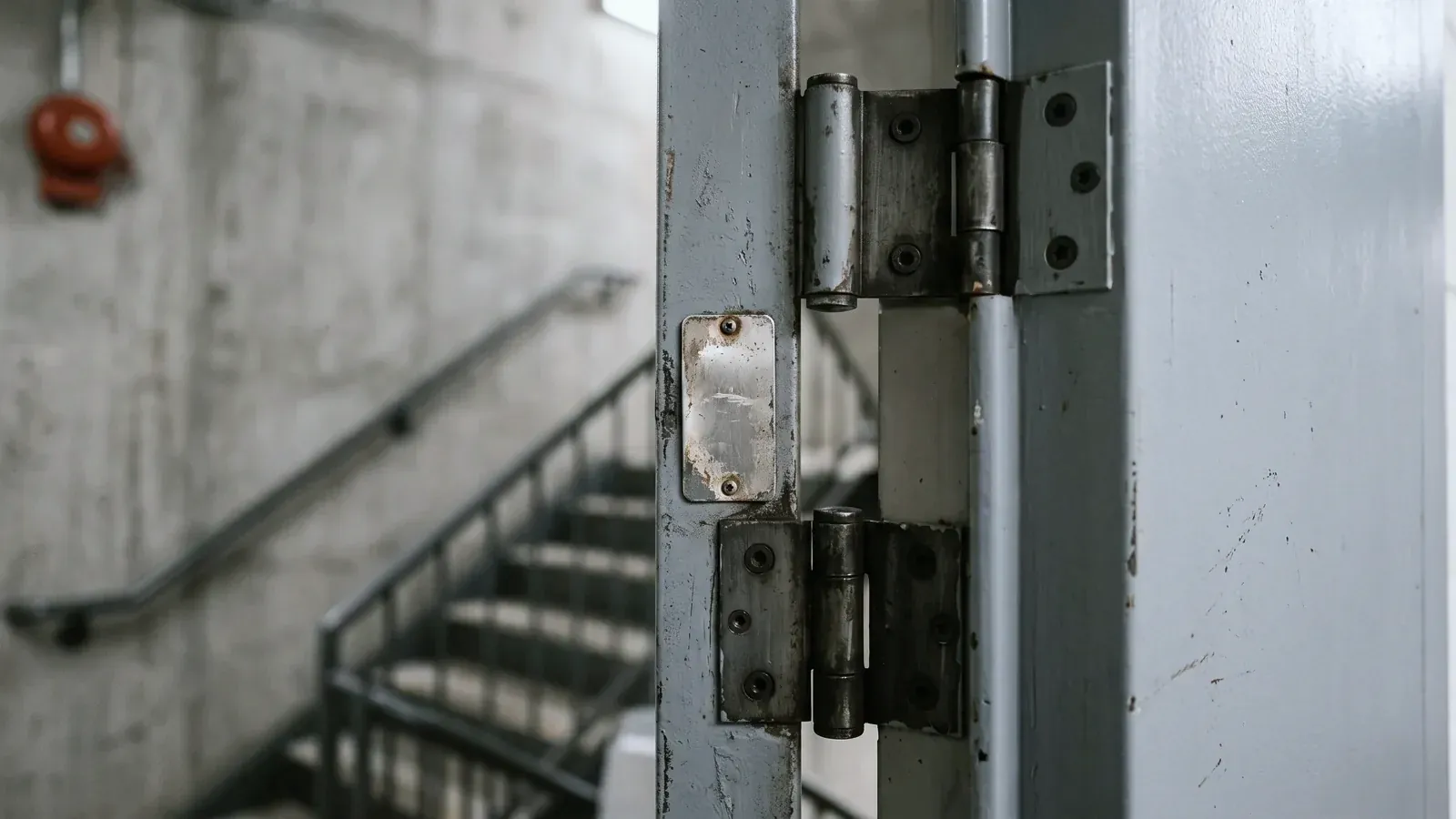
Fire door inspection checklist
NFPA 80 spells out 13 checks for each swinging fire door during the annual visit. The check is done by eye, with the inspector viewing the door from each side.
Here are some of the items checked on every door:
- Labels: the door itself, the frame around it, and any windows carry a label proving the product passed testing and listing.
- Damaged or missing parts: no component of the door itself or any of its hardware is broken.
- Clearance: the gaps along the door's edges fall within permitted limits. Clearance is the gap between a shut door and the frame around it or the floor beneath.
- Closing and latching: the door closes and catches on its own.
- Signs: any signage on the door stays within the allowed size and mounting rules.
- Gasketing: seals sit in place where required. Gasketing is a seal running along the door's edges that keeps smoke out. It's only required if the fire door also has to serve as a smoke barrier.
- Glass: the rated glass remains in place. Swapping in regular glass where fire glass belongs voids the door assembly, according to one door supplier.
Who can inspect a fire door?
The work must be done by a qualified person familiar with the kind of door under review. NFPA 80 asks for no particular certification for whoever performs the inspection.
Your local fire code official, formally called the authority having jurisdiction (AHJ), decides what proof and records they'll accept.
Are fire doors and inspectors certified?
There are two sides to this question: the door itself, and the person who inspects it.
For the door, the label is the proof. Every fire door, frame, and fire door window must carry a label proving it passed testing and listing. Listing means an independent testing agency evaluated the product and put it on its approved list. NFPA says the label has to include details like the manufacturer's name.
When a label is gone, other evidence your AHJ accepts, like a report from a certification service, can stand in for it. Labels can be painted over only if they stay readable, though NFPA advises against it. If a label is gone or painted over, talk to the manufacturer and your AHJ about getting the door relabeled before replacing the door, since a fresh label might spare you the price of a replacement door.
On the inspector side, the Door and Hardware Institute provides the CFDAI credential (the letters stand for Certified Fire and Egress Door Assembly Inspector. NFPA 80 doesn't demand it, but it gives an inspector one way to show training.
Are signs allowed on a fire door?
Yes, they are, though NFPA 80 restricts their size and how they're fastened. If a sign is made of combustible material or thin vinyl, it may take up no more than 5% of the door face. It's worth checking the size and how it's attached before you put one up.
Inspection records to keep
Every inspection record must be signed and stored where your AHJ can review it. Hold on to those records for a minimum of 3 years. The acceptance test, meaning the first test performed after installation, is documented for as long as that door assembly stays in service.
Frequently asked questions
What does a fire door inspection cost?
Published estimates vary by building size and number of doors. These numbers come from companies that perform this work.
| Building or unit | Reported cost | Source |
|---|---|---|
| Each swinging door | Roughly $35 per year | Inspection company blog |
| Smaller or mid-size property | $200 to $800 | Locksmith blog |
| Bigger property | Over $1,500 | Locksmith blog |
| 200-bed hospital | Around $7,000 per year | Inspection company blog |
How often must fire doors be inspected?
On top of the annual check, a door must be inspected and tested following installation and after any maintenance or repair. NFPA 80's 2013 edition brought in these extra checks, so a repaired door doesn't sit unexamined until the next annual visit.