
Fire alarm installation cost
For a business, fire alarm installation cost typically falls between $1.25 and $12 per square foot installed, based on one fire protection contractor's cost guide. The spot your project lands in that spread comes down to the building's size, the kind of system you choose, and whether the space is new or already built out.
- Installed price $1.25 to $12 for each square foot
- Addressable systems 30 to 50% above conventional
- Existing buildings 20 to 40% above new construction
- What you'll spend each year after the work is done $600 to $2,000 or more
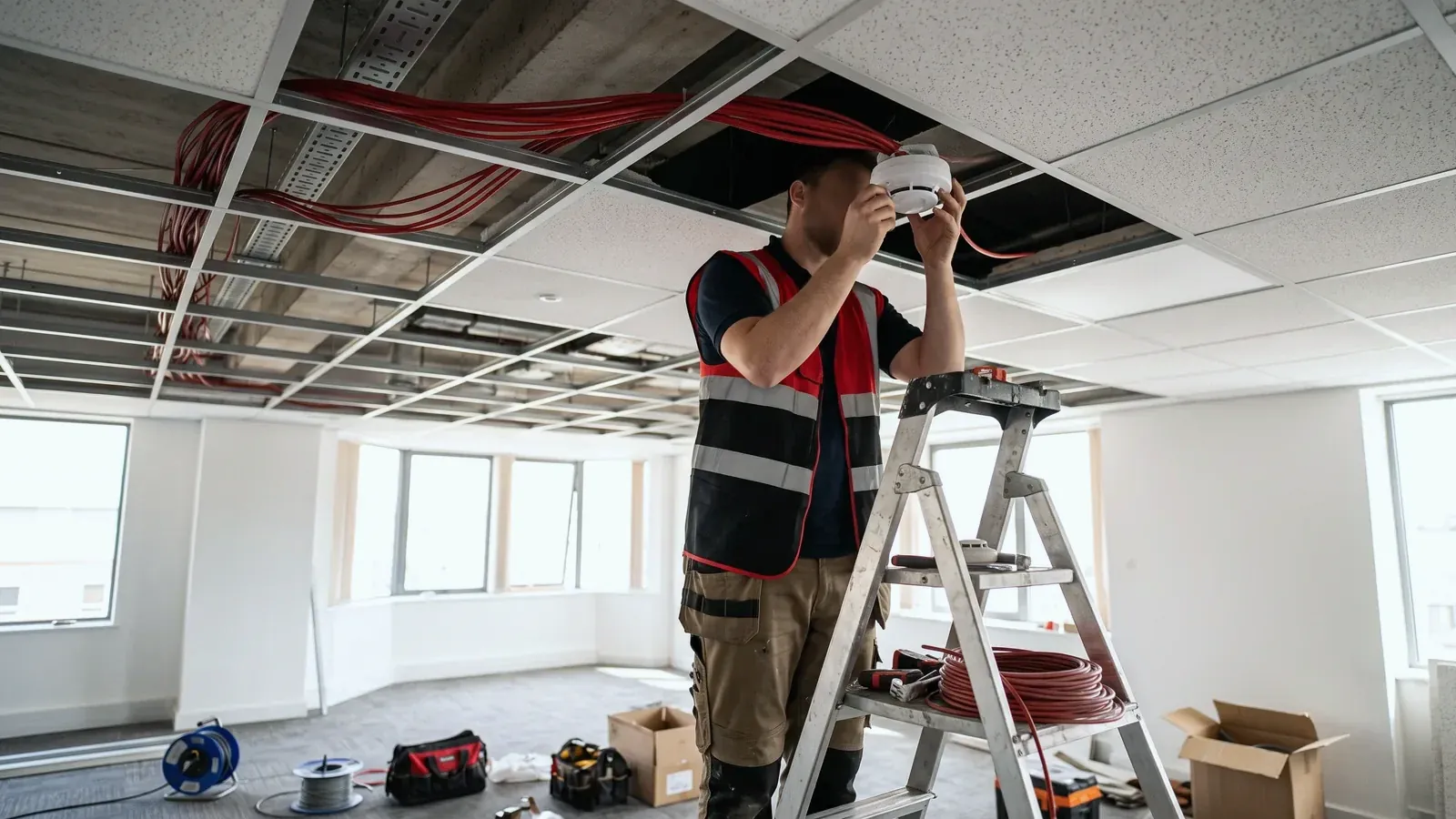
How does price change with building size?
Building size is the biggest factor in what you'll pay. More square footage means more detectors, more wiring, and stronger signals so every person hears the alarm. Here are the totals from the Total Fire Protection guide.
| Building type | Full installed price |
|---|---|
| Compact office space of 2,500 sq ft | $3,000 to $6,000 |
| Mid-size retail shop of 5,000 sq ft | $6,000 to $11,000 |
| Big office floor of 10,000 sq ft | $12,000 to $25,000 |
| Storage warehouse of 25,000 sq ft | $40,000 to $150,000 |
| Tall tower of 50,000 sq ft or more, with voice evacuation | $100,000 to $400,000 |
A guide from a security company comes in lower. It lists basic small business setups at $1,500 to $3,500, and complicated projects topping $10,000.
What makes up a commercial fire alarm system?
Each setup includes a control panel, detectors, manual pull stations, plus horns paired with strobes. The NFPA, the group behind the national fire codes, describes the control unit as the brain of the system. It reports 3 condition types: alarm, supervisory, and trouble.
These figures cover equipment only, before labor, sourced from the same contractor guide.
| Component | Cost each |
|---|---|
| Main control panel | $2,500 to $6,000 |
| Smoke sensing detector | $15 to $90 |
| Heat sensing detector | $20 to $160 |
| Manual pull station | $25 to $110 |
| Horn with strobe | $45 to $250 |
The panel tends to be the priciest single line on any quote, so ask each bidder which model they're pricing.
Does an addressable fire alarm system justify the extra cost?
With an addressable system, every detector carries its own address, so the panel pinpoints the exact device that triggered. A conventional setup only sorts detectors into zones, which tells you the general area rather than the specific unit.
A conventional setup runs $3,000 to $10,000, which works well in smaller, simpler spaces. Addressable systems add 30 to 50% to the price, landing at $10,000 to $50,000 or more, and they're the usual pick for medium and large buildings.
Wireless systems come in at $8,000 to $35,000. They show up in existing and historic buildings, since the detectors work without pulling wire through finished walls.
What pushes the price up?
A retrofit is when a system goes into a finished building instead of one still being built. A retrofit costs 20 to 40% more compared with working in new construction.
Any ceiling over 20 feet calls for special gear to reach it, and that adds to the bill. Tall buildings can also require voice evacuation, which moves high-rise totals toward the upper end. Get a second quote. On a job this size, a second bid is normal, and it often shows which line items the first shop left out or padded.
How a fire alarm system gets installed
Design and wiring each follow their own code. The designer works under NFPA 72, the national fire alarm code, while the electrician wires to the National Electrical Code.
- First, the design follows NFPA 72, the code that dictates device placement and system performance.
- Next come shop drawings: detailed plans mapping each device and wire run. The building code requires these to go through review and approval before installation.
- Wiring then goes in under Article 760 of the electrical code, the section dealing with cable types, junction boxes, and how the wiring is protected.
- Finally, the local fire-systems authority inspects the finished job and can reject anything that falls short of code.
When is it time to replace an old system?
Typical triggers for replacing a system include it being outdated, malfunctioning, under open recalls, or impossible to source parts for. NFPA 72 doesn't make you swap out a system only because it's obsolete. Still, if you can't get parts, planning a phased replacement is the smart move.
That planning matters because an emergency swap costs significantly more. You could pay overtime on the install plus the cost of a fire watch, where people walk the building watching for fire while the alarm is out of service.
If your system is past 20 years old, take time to reassess what the building actually needs before replacing anything. A straight one-for-one device swap might not satisfy current code, and the local authority can turn the new system down.
Ongoing costs after installation
The spending continues after the install is done. Expect another $600 to $2,000 or more each year; build that into your budget from day one.
Common questions
What does a commercial fire alarm system require?
Past the design, wiring, and drawing rules, some locations need extra steps. The building code says a campus whose total occupant load reaches 1,000 or more must complete a mass notification risk analysis before any new alarmed building goes up. If that analysis shows a need, the building gets a mass notification system.
What is a mass notification system for?
It broadcasts emergency messages throughout the building. NFPA 72 Chapter 24 governs this equipment: it allows manual and automatic activation and sequences messages according to an emergency response plan. The chapter lays out 4 layers: inside the building, outside it, personal devices, and the wider public.
Who handles the design of these systems?
Often a fire protection engineer, sometimes called a fire safety engineer. Their work applies science and engineering to detection and other safety systems. An architect or building owner can bring one in as a consultant to plan or check a building's fire protection. These engineers can sit for a licensing exam in fire protection.