
When is a fire alarm system required?
Whether a fire alarm system is required comes down to what your building is used for, how many floors it has, and how many people are inside. This check follows the 2021 model building code (IBC); your local fire marshal has the final say.
1 of 3
What is the building used for?
When is a fire alarm system required, by building type?
Buildings are sorted into use groups by the 2021 International Building Code (IBC), which is the model code that most states adopt. Each group has its own alarm trigger set by Section 907.2. Find your building's use, and then see when that group calls for an alarm.
| Building use | IBC group | An alarm is required when | Section |
|---|---|---|---|
| Restaurant, bar or event hall | A-2 | At least 300 people, or more than 100 on any floor other than the street exit level | 907.2.1 |
| Office, bank or clinic | B | You need an alarm when the total number of people across every floor is 500 or more, or when one floor above or below the street exit holds more than 100 people. One is always required in ambulatory care facilities. | 907.2.2 |
| Store or shop | M | Covered malls and open malls are governed by IBC 402. Outside that rule, you need an alarm when all floors together have 500 or more people, or when one level above or below the street-level exit holds more than 100 people. | 907.2.7 |
| School or daycare | E | Once the space holds more than 50 people, an alarm is required, and once it holds more than 100, a voice alarm is needed. | 907.2.3 |
| Apartments or condos | R-2 | This rule covers a building with over 16 units, or one where any unit is 3 stories or higher above the street exit. The same applies if any unit is over 1 story below that exit. | 907.2.9.1 |
| Hotel or motel | R-1 | Every hotel and motel must have an alarm. The only case that is exempt is a building with 2 stories or fewer whose rooms all open directly outside, behind walls with a 1 hour fire rating. | 907.2.8.1 |
| Church, theater or gym | A-1, A-3 | At least 300 people, or more than 100 on any floor other than the street exit level | 907.2.1 |
| Factory | F | A structure of 2 or more stories must have an alarm when the number of people above or below the street exit reaches 500 or more. | 907.2.4 |
| Warehouse or storage | S | An alarm is needed in the halls and common areas of self-storage buildings with 3 or more stories. High-piled storage has its own rule at 907.2.15. | 907.2.10 |
| Hospital or nursing home | I | The rule applies to every Group I building, including hospitals, nursing homes, jails, and some care homes. | 907.2.6 |
| High-hazard plant (Group H) | H | This applies to Group H-5 (semiconductor plants), plants that make organic coatings, and smoke detection for certain toxic chemicals. | 907.2.5 |
| House or townhouse | IRC (homes) | No building fire alarm system. Smoke alarms go in each bedroom, outside each sleeping area and on every level. | IRC R314 |
Any room holding fewer than 50 people counts as an office, not an assembly space. That's why a small cafe often falls under the office rule.
Fire alarm systems in apartment buildings
An apartment building needs an alarm once it has more than 16 units. Any unit that sits 3 stories or higher above the street exit also falls under the requirement.
A unit sitting more than 1 story below that same exit also falls under the rule. The building's size doesn't matter: each unit still needs its own smoke alarms.
When a fire alarm is required for your building
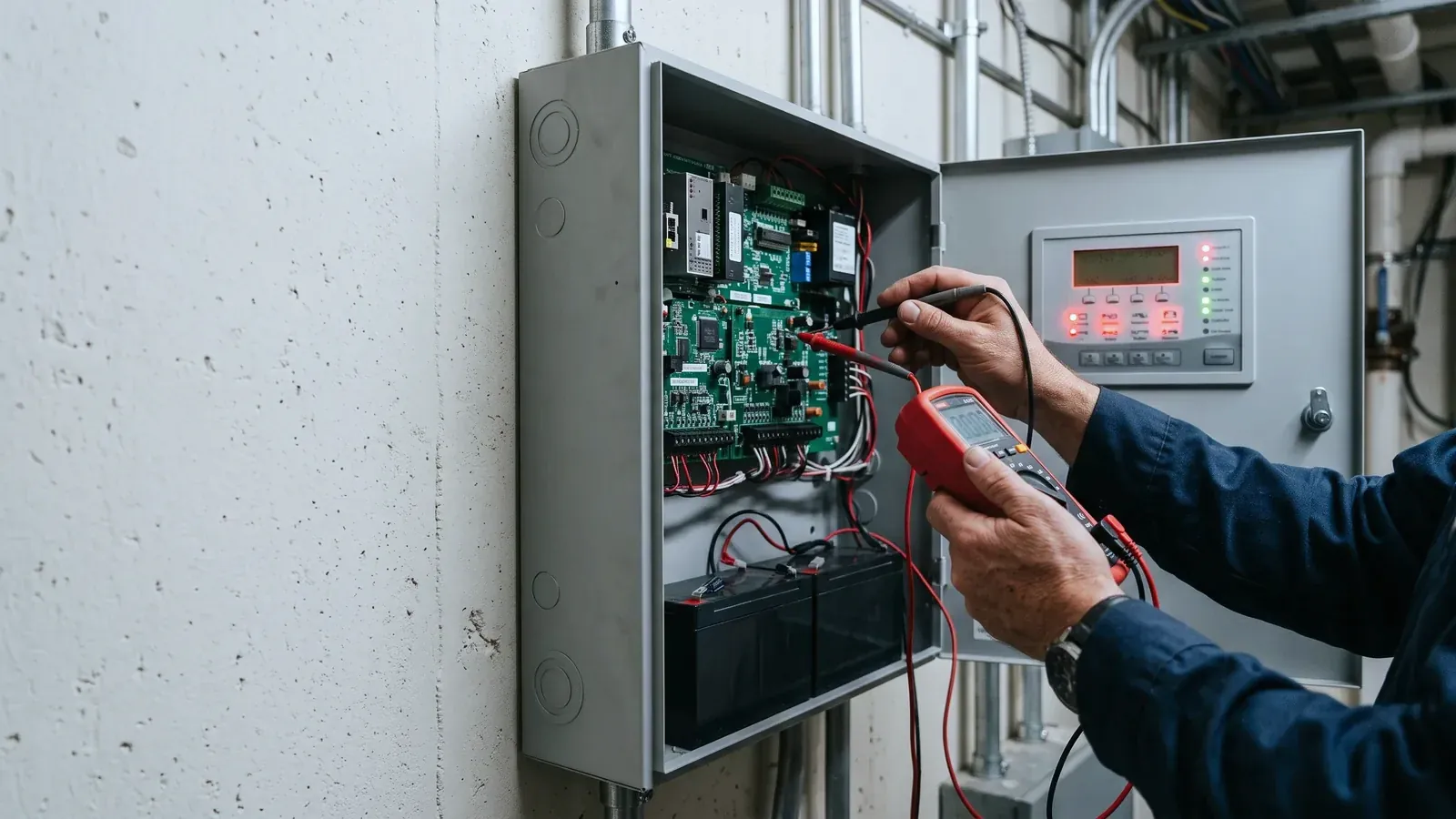
A new system usually comes with a control panel, horns and strobes, pull stations by the exits, and smoke or heat detectors wherever the code requires them. The fire code's Section 907.6.6 says a required system has to report to a monitoring center too.
To see typical prices, check fire alarm installation cost. See fire alarm monitoring for the ways a panel can send signals to the monitoring center.
How this answer was reached
The source is Section 907.2 of the 2021 International Building Code (IBC), and the same rules appear in Section 907.2 of the 2021 International Fire Code (IFC). New buildings and structures follow IBC 907.2, while the AHJ decides the fire code rules for existing buildings.
- IBC 907.2.13 treats a building as a high-rise when a floor is over 75 feet above fire truck access. That triggers smoke detection and a voice alarm.
- Even if a building already has automatic smoke detectors or sprinkler flow switches, you must still install at least 1 manual pull station (IBC 907.2).
- IBC 303.1.1 puts an assembly space holding fewer than 50 people in Group B, not Group A.
Chapter 9 of the 2021 Seattle Building Code reproduces IBC chapter 9, so you can read the same rules there.
This answer follows the 2021 model building code (IBC). Your state or city may use a different edition or add rules, so check with your local fire marshal, also known as the AHJ (authority having jurisdiction).