
Kansas fire code
Kansas bases its fire code on the 2006 International Fire Code, though your city or county may demand more than that. So the rules that apply to your building come from the state and from your local fire office together.
Code in force: 2006 IFC with state exclusions. Enforced by: Kansas Office of the State Fire Marshal. Your local fire marshal can add rules, so check with that office too.
- statewide baseline fire code edition 2006 IFC
- adopted in Sedgwick County Fire District 2024 IFC
- enforces state code and registers contractors State Fire Marshal
- required for fire extinguisher service businesses Annual certification
Asking about a house? For a house or duplex, smoke alarm and sprinkler rules usually come from the residential building code (the IRC) instead, so ask your local building department.
The fire code Kansas uses statewide
The International Fire Code is a template, a ready-made collection of rules for fire safety, which states and cities can take up and enforce as their own. Kansas adopts the 2006 edition by reference through K.A.R. 22-1-3, with its appendices included and certain listed chapters left out.
Your town is free to go beyond these rules. According to the state fire marshal's office, local areas can set tougher requirements, but never weaker ones than the state asks for. That means two buildings in nearby towns may have to meet different rules, and whichever rule is stricter is the one your building must meet.
Alarm, sprinkler, and extinguisher standards
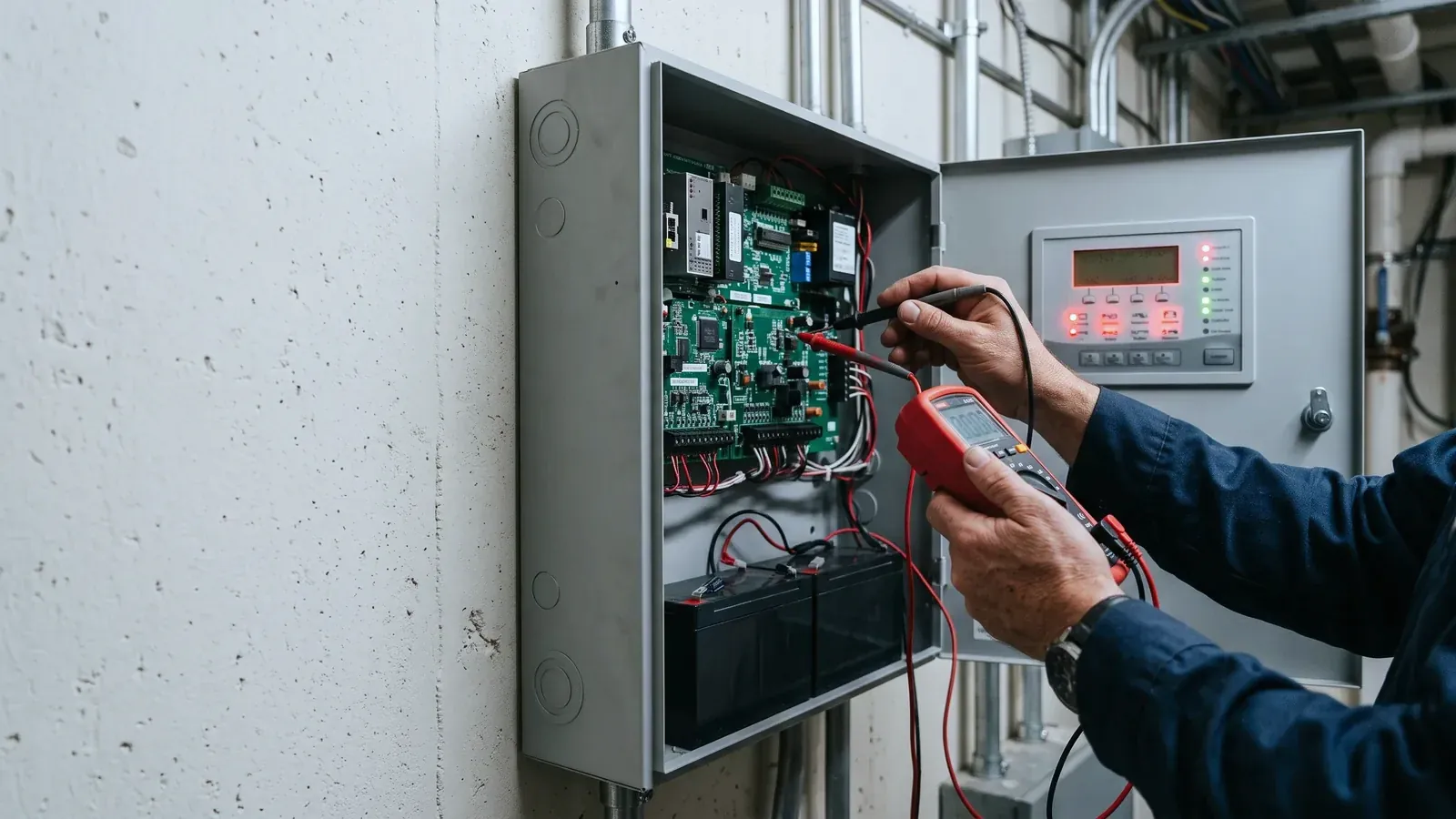
Kansas also takes on standards from the National Fire Protection Association, the group that writes the detailed rules for fire equipment. Under the Kansas Fire Prevention Code, each kind of system follows a set edition.
| Code or standard | What it applies to | Edition in force |
|---|---|---|
| International Fire Code | Overall fire code | 2006 |
| NFPA 101 | Life safety provisions | 2006 |
| NFPA 72 | Fire alarm systems | 2007 |
| NFPA 13 | Installing sprinklers | 2007 |
| NFPA 10 | Portable extinguishers | 2007 |
| NFPA 25 | Inspection, testing, and maintenance of water-based systems | 2008 |
If your alarm, sprinklers, or extinguishers are due for service, call us to have them checked against the edition that applies to yours.
New construction, additions, or a change of use
A code footprint is a drawing that lays out how a building satisfies the fire code. The state requires one for new construction, additions, renovations, and changes in a building's use. A design professional licensed in Kansas must prepare it. Single-family homes and duplexes don't need one.
Sedgwick County Fire District rules
The Sedgwick County Fire District uses a newer code for new plan reviews. The Sedgwick County Fire District put the 2024 edition of the International Fire Code into effect on 16 January 2025, so every new plan review there is measured against that edition. Plans drawn to the 2006 state code alone won't line up with what the district reviews. Call us before any building or remodeling there, so your plans can begin from the correct edition.
The Kansas fire marshal and the office's decisions
Across Kansas, the state fire marshal supervises how the fire code gets applied. If a city or county modifies an adopted fire code, it has to send the fire marshal a summary, and the marshal approves or rejects it, giving notice within 30 days.
When a local rule or state law clashes with the fire prevention code, it's the fire marshal who decides after holding a hearing. Under K.S.A. 31-142, that decision can be appealed.
Is a variance from the fire code possible?
Yes, in some cases. A variance is formal permission to satisfy a rule another way, or to be excused from it entirely. On a written application, the state fire marshal may grant one because of hardship or to allow a new method, but only when no immediate danger to life exists. Not sure a variance would work for your building? Call us before you apply.
Who may service your fire equipment?
Any company installing or servicing sprinkler, detection, or alarm systems has to register with the state fire marshal. A company just starting out has to file a notice of doing business no later than 30 days after beginning work, unless its work is limited to 1 and 2 family homes. For code violations, the state may refuse, suspend, or revoke that registration, and the company then has 15 days to appeal.
Extinguisher work follows its own rules. A company needs certification from the state fire marshal before it can inspect, install, or service portable extinguishers or the automatic units above commercial cooking equipment.
- The certification comes up for renewal each year, at no cost.
- It depends on the training of named staff, and proof of that training goes to the fire marshal.
- It lapses if the qualified person it rests on leaves the company.
- The rules also lay out testing standards and minimum insurance.
Under the Kansas consumer protection act, it's a deceptive act for a company to inspect or service extinguishers without state certification. Installing an extinguisher to protect your own property or business is exempt, since that isn't treated as a regulated business. Need extinguisher service for a restaurant hood or office? Call us now to discuss what your equipment needs.